Startup Cities
Is Cambridge Only for Super Geniuses Who Want to Spend Their Whole Life in a Library?
The startups actually hiring interns and new grads in Cambridge right now, company by company — with direct links to every open role.
Ceeve Team · 2026-08-13 · 5 min
We asked Ceeve. Apparently not.
If you're into startups, or you just want to work somewhere you actually own something from day one instead of doing slides in a corporate internship, Cambridge has one of the deepest science-to-startup pipelines in the world right now.
AI materials discovery, techbio, neurotech, hydrogen, RF hardware. There's a whole wave of University of Cambridge spin-outs growing fast here right now, and not just the big names. A lot of smaller pre-seed and seed teams are actively hiring interns and new grads. One of them just raised $450M backed by Jeff Bezos.
If you're a student, a recent grad, or someone tired of being employee #4000 somewhere, this is your sign.
Here's what's actually happening in Cambridge right now, company by company.
AI & Materials Discovery
CuspAI — Uses generative AI to discover new materials for semiconductors, clean energy, and chipmaking, compressing years of lab-based research into a fraction of the time. Went from a $520M valuation to $2.6B in under a year, with a $450M Series B backed by Bezos Expeditions, Kleiner Perkins, and NEA, and partnerships with ASML, Meta, and Hyundai.
Intellegens — A University of Cambridge spin-out whose Alchemite™ machine learning platform finds patterns in sparse, messy R&D data that other AI approaches can't handle, cutting the experimental workload for materials, chemicals, and drug discovery teams by up to 90%. Named Cambridge Independent's AI Company of the Year.
Hiverge — Founded by former Google DeepMind researchers behind AlphaFold and AlphaEvolve, Hiverge builds an AI "discovery engine" that automatically writes and tests novel algorithms to solve business optimization problems, from delivery routing to product recommendations. Backed by Jeff Dean and Flying Fish Ventures.
Tenyks — A Cambridge University spin-out and Y Combinator company building tools that help machine learning engineers find and fix what's wrong with their computer vision models, faster than manual review. Landed its first Fortune 500 customer and was named Company of the Year at Cambridge (previously awarded to DeepMind).
Conundrum — An industrial AI platform giving mining, steel, and chemical plants real-time closed-loop control over crushing, grinding, and smelting processes to boost output and cut energy use. Deployed across 9 plants in 7 countries and says it's added over $130M in EBITDA for clients.
Techbio & Neurotech
CardiaTec Bio — A University of Cambridge spin-out using AI on large-scale human heart tissue data to find new drug targets for cardiovascular disease, the world's leading cause of death. Runs a network of 65+ hospitals across the US and UK collecting cardiac tissue for its dataset, and its founders were named Forbes 30 Under 30.
Vector Bioscience — Spun out of Cambridge's Department of Chemical Engineering, Vector is building an ML-designed nanoparticle platform that delivers cancer drugs directly and precisely to tumor tissue, reducing the side effects of conventional chemotherapy. Has raised over £3M in non-dilutive funding and shown proof-of-concept in some of the hardest-to-treat cancers.
Coherence Neuro — Founded by two Cambridge PhD researchers, Coherence is building an implantable brain-computer interface that listens to a tumor's electrical activity and delivers targeted stimulation to manage cancer, starting with glioblastoma, in real time rather than reactively. Raised a $10M seed round backed by Blackbird and Topology Ventures.
Tolemy Bio — Based at Cambridge's Future Business Centre, Tolemy is building Orbit, an AI platform that pulls together scattered lab data (spreadsheets, notebooks, equipment logs) into one system so biopharma teams can predict and control cell behavior for cell therapy manufacturing. Just raised €1.4M pre-seed led by Norrsken Evolve.
Qureight — Founded by two doctors, not engineers, Qureight builds AI tools that read complex lung and heart CT scans to speed up clinical trials for pharma companies. Just closed a $20M Series B and already runs trials for AstraZeneca and Bristol Myers Squibb.
Hardware, Hydrogen & RF
Levidian — Originally spun out of Cambridge in 2012 as Cambridge Nanosystems, Levidian's LOOP technology cracks methane into clean hydrogen and high-grade graphene, giving hard-to-abate industries a way to decarbonize while creating a valuable graphene by-product. Aiming for 50,000 tonnes of graphene production by 2030.
Forefront RF — A fabless semiconductor company building a tunable duplexer that replaces the bulky, fixed-frequency filters inside smartphones and smartwatches, freeing up circuit board space for more features. Closed a £16M Series A and is launching its first chip into the cellular smartwatch market.
Sparxell — A University of Cambridge spin-out making plant-based, fully biodegradable colour pigments and glitters from wood pulp cellulose, replacing the toxic synthetic dyes used across fashion, cosmetics, and packaging. Has piloted with LVMH brands including Louis Vuitton and Dior, and raised €4.2M to scale to tonne-level production.
Climate, Food & Energy
Uncommon — A Cambridge cultivated meat startup using stem cells to grow real pork without the animal, aiming to make cultivated meat mainstream. Backed by Sam Altman among others, it raised a $30M Series A to bring costs down and pursue regulatory approval.
Neutreeno — A spin-out from Cambridge's Department of Engineering, Neutreeno gives businesses a real-time B2B platform for tracking and cutting greenhouse gas emissions across their supply chain, with one manufacturing client reporting over €1.6M in annual savings from the efficiency gains alone.
NODI Energy — A Y Combinator-backed company building plug-in home batteries that need no electrician or rewiring, aggregating them into a distributed virtual power plant that eases grid congestion and helps data centers connect to power in weeks instead of years.
Fashion & Industry
Hyran Technologies — Built by a Cambridge computer science PhD whose family ran a textile factory, Hyran gives fashion brands real-time visibility into supplier capacity so they can produce closer to actual demand instead of guessing months ahead, cutting the overproduction that drives the industry's waste problem. Backed by Closed Loop Partners.
Enterprise Software
Gearset — Built by developers who spent years working on release tools at Redgate Software, Gearset makes it dramatically easier for engineering teams to deploy, test, and back up changes on the Salesforce platform. Now serves 3,500+ companies including IBM and McKesson, and just won Best Company to Work For at the UK Company Culture Awards.
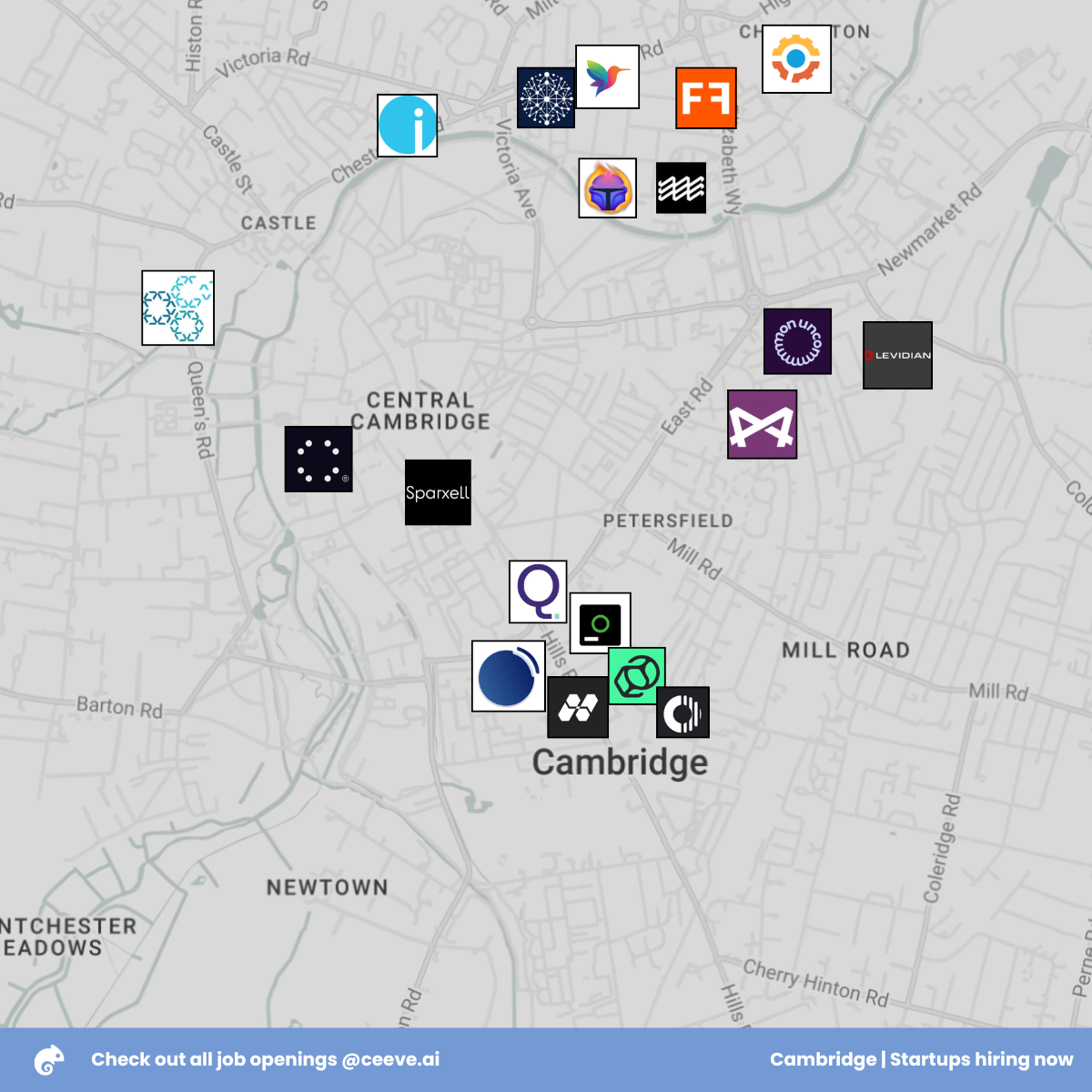
Direct links to every open role at these companies are on Ceeve — no aggregator listings, no dead links, just the actual application pages.